I hear a voice inside my head. He tells me that I’ll soon be dead. “You said that to me once before. As then, I’ll answer you once more!”
He shrieks at me and makes a clatter ’til him with Q-tip I do splatter. Now once more my head is quiet. From tiny ear invader’s riot.
I’m not making light of actually having this type of mental health problem. I’m also not encouraging anyone to put Q-tips in their ears (which is potentially dangerous.) Further, I do not condone murdering any teeny tiny doomsayers with Q-tips, whether said doomsayer is inside your ear or not.
I have always enjoyed reading “madness” when written well. One thing that I think is important to doing it well is that the thing which seems crazy to the reader, or to sane characters in the narrative, needs to make a certain kind of sense from the perspective of the insane character. The Reader should know why the crazy character is operating outside of reality, but also why he/she is misinterpreting events.
This is a phenomenon that is completely real. I’m not sure what it says about our brains, though. I mean… the part of your brain that was unhappy was at the meeting wherein the other part of your brain announced that everyone was going to not only ignore the unhappy part, but actively work against it. In short order, with no other changes, the unhappy part of the brain changes its mind and joins everyone in happiness.
It makes sense that the part of our brains wherein reason resides should govern the part wherein emotions dwell. That said, we live in a culture wherein nearly everyone makes their own feelings of paramount importance. What if doing that is exactly the wrong approach to living a happy life and maintaining a happy society?
Rumination involves repetitive thinking or dwelling on negative feelings and distress and their causes and consequences. The repetitive, negative aspect of rumination can contribute to the development of depression or anxiety and can worsen existing conditions.
When a person who is in a depressed mood ruminates, they are more likely to “remember more negative things that happened to them in the past, they interpret situations in their current lives more negatively, and they are more hopeless about the future.”1 The preoccupation with problems also makes it difficult to move beyond to allow for a focus on problem solving. Even in people without depression or anxiety, rumination can contribute to negative emotions. This can become a cycle where the more a person ruminates, the worse they feel, which then contributes to more rumination.2
A study in the University of Liverpool in the United Kingdom looked at the connections between a person’s circumstances and past experiences and development of depression and anxiety. Researchers, led by Peter Kinderman, Ph.D., found that the most important way that a person’s past experiences, such as traumatic life events, led to depression or anxiety was “by leading a person to ruminate and blame themselves for the problem.”3 “Depression and anxiety are not simple conditions and there is no single cause,” Kinderman noted in a statement. “Whilst we can’t change a person’s family history or their life experiences, it is possible to help a person to change the way they think and to teach them positive coping strategies that can mitigate and reduce stress levels.”
“This is a beautiful old car and you’ve taken great care of it, so do you mind me asking why you’re selling it?”
“To be honest, I don’t want to,” the old man began “but my kids are telling me it’s time, I don’t want to fight with them about it anymore, and God help me if something ever happens to prove them right.”
I had a lot of feelings about his answer and the look in his eyes when he gave it, and I wanted to tell him I was sorry, but instead I just said that I was thankful to be the lucky guy he is selling it to, before handing him a check, wishing him well, and driving away.
If we are very lucky, most of us will eventually end up on both sides of this type of exchange. Of course, it does not feel like luck, for most people, to be on the latter end.
Writing this story was a bit like “adventures in compound sentences” to get it in under the limit, but I think it worked even if it also feels like I cheated.
Heaviness fills the air Halls once beating with life Now have nobody there
Ghosts and memories roam But leave no marks in dust Spread thick upon my home
I live still but am rotten A spirit burdened by time And purpose now forgotten
__________________________
It is possible to die before you have died and for the past to be more present than the present. It doesn’t need to be this way, but all too often it is.
This feels like a SWS that works as a story prompt, too. Is this what the jewel thief says to him or herself during a heist? Is this what a gold-digger thinks internally during the exchange of rings at a wedding ceremony? Is this something a bitter divorced person sarcastically mutters when looking at his/her wedding photos?
You can choose your own adventure – which is i guess how “prompts” work.
Far beneath the ocean deep Where Hydra lurked and fish now sleep A relic of Atlantis waits To travel up from Hades’ gates
For once it was the scourge of men And there it waits to be again Into the deep it once was cast Into the deep, the deepest past
When gods came down and cursed mankind With offspring that they left behind From daughters of Creation torn A hybrid race of giants born
Their numbers grew, they built a kingdom, And vowed to all from God their freedom Their island capital – an Eye That stared in menace at the sky
They raped and murdered, robbed and ruled They sinned and slandered, tricked and fooled Humanity was soon replaced Adam’s sons almost erased
Then in a moment God descended From damnation, he defended The Creation from corruption — The earth exploded with eruption
Water poured from up and down And then the wicked ones did drown An ark of life preserved the rest Of those good whom God had blessed
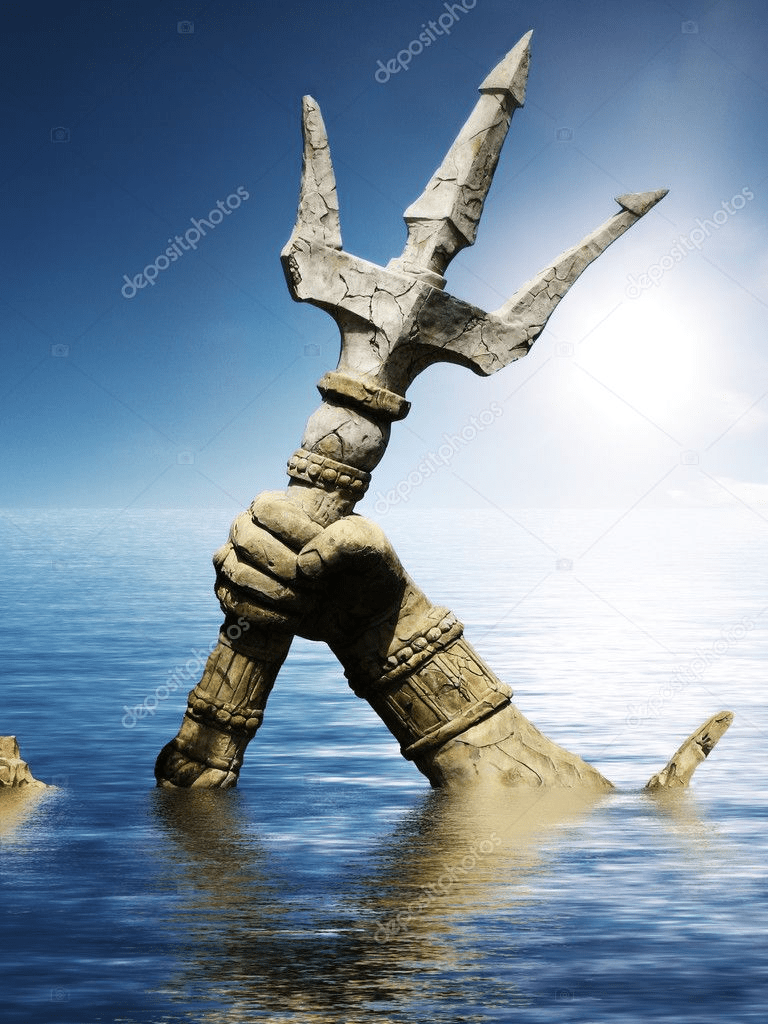
The usurpers’ king with God did match And the Lord of Hosts did him dispatch By ripping from his fist a spear, A three-pronged tool that all did fear
The devils were next locked away In Hell awaiting Judgment Day The city where they lived wiped clean From Earth – as though it’d never been
But left behind were rebel traces For those who search in darkest places Ancient evil sorceries And offspring, too, God’s forgeries
The remnant who survived the Flood Retained corruption in their blood The evil hybrid race returned And God once more by them was spurned
New Rephaim dwelled within Canaan Where some there built alters to Dagan But though they were vicious and bold The Holy Land they could not hold
Though dead, the giants’ souls remain To possess hosts, as theirs were slain Wraiths who seek to dominate, Through human flesh they infiltrate
Now lurking demons search the waves The desert sands and deepest caves They also search through earth’s dark mud For bones to clothe with flesh and blood
Most of all they seek a key To unlock immortality Neptune’s defeat his trident cost Somewhere deep and dark is lost
It is the tool to unlock hell To free the rebels from their cell To wage again the war of old To rage as it has been foretold
Far beneath the ocean deep Where Hydra lurked and fish now sleep A relic of Atlantis waits To travel up from Hades’ gates
_________________________
When I first published this, I was reading The Hobbit. After ingesting The Misty Mountains Cold, I was inspired to try writing something that tells a story about a powerful, lost ancient relic.
On the whole, I’m happy with it. It still needs some work, though. I could probably make some minor changes and smooth out the meter. Also, on its own, it feels too long and that it’s doing too much info dump. But maybe if you planted something like this in the middle of a book, wherein this story is already kind of known to the Reader, then it probably works better.
The poem above is kind of an amalgamation of established history, religious history, mythology, and apparently also the movie Aquaman (though I didn’t really realize the last until I was well into the writing.) I hope this goes without saying, but in case it does not, I am not trying to make any serious claims about a correlation between a potentially real “pre Great Flood” Atlantis, the plot of the movie Aquaman, ancient giants, the idea of pantheons being related to the Bible’s account of The Watchers, etc. It’s just a story. I’m definitely not trying to offend anyone.
That said, it is fascinating how widely we see tridents depicted in the various pantheons stretching from India to Rome. In India, Shiva carries a trishula (trident.) In Greece, Poseidon carries it. In Rome, Neptune wields it. The Hittite weather-god Teshub is depicted wielding a thunderbolt that looks very trident-like. In Taoism, there is also a trident, though it is more symbolic than weaponish (it represents the Three Pure Ones.) There are many other such examples and scholars will tell you that as all of these pantheons and related ideas are offspring of the Proto-Indo European pantheon… and that traces of the original beliefs survived and were carried forward as those beliefs evolved over time in various localities.
If mankind ever does find a 12,000 year old trident at the bottom of the ocean, I’d advice everyone to leave it where it lies and definitely to avoid using it. Odds are that it will end up on display in the British Museum.
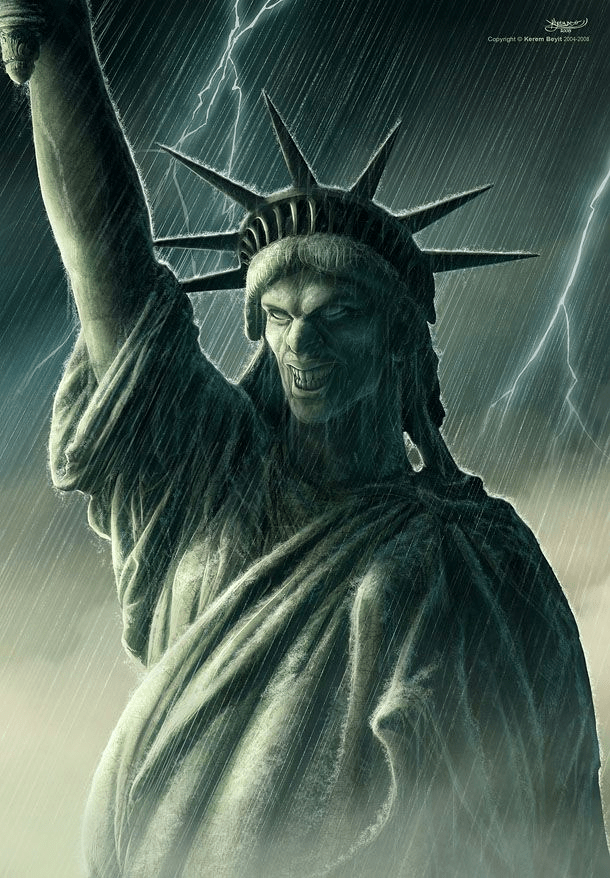
Through the window, the image of a large green woman holding aloft a torch comes into view in the distance. Her presence cements into reality, for Boryslav and his family, a relocation that none of them could have foreseen just a few months ago.
While he thinks on what it means to be a refugee, he looks more intently and notices a sinister smile on the great lady’s face.
I always enjoy – in good storytelling – when the characters think they have reached a place of safety only to learn that they have been lured into a trap. The Statue of Liberty is so often used as a positive symbol that it felt like good material to use for subversion of expectations.
Obviously I am not the only one who has had this particular idea.
This probably happens more often than the average person realizes, either for altruistic and familial reasons, or because a guilty rich person paid someone a lot of money to confess and spend a few years behind bars in his or her place. I bet most readers probably instinctively assumed the “altruistic and familial reasons” in association with my story. The word “protect” kind of conjures that sentiment up. Is there a better word than “protect” if the Speaker is doing it for money?
If one can set aside the ethical, legal, and moral implications of this type of action (obviously that can’t happen – but for the sake of the thought exercise we’ll pretend we can), I wonder what the amount of money would be wherein I would agree to give up that much of my life.
Does everybody have a price? I’ve been wrestling wit that question for decades.
Sleeve of Oreos Silent like a sly raccoon I dine in the night
Eating an uncomfortable (for others) number of Oreos in the silent and judgment-free zone of night is not as easy as it sounds. I think the plastic packaging is designed to break the quiet so dramatically that it wakes up your neighbors. The trick is to hurry slowly.
I am consistently impressed with the innovations that occur at this cookie company, too. First they wowed us with doubling the stuffing. But these days you’ve got various and sundry flavors as well as options wherein the cookie is covered in things like fudge. Adam Smith can eat his heart out because I doubt there’s a better argument for capitalism than Oreo cookies. There have even been trickle down benefits for the medical industry, too.
It is rarely a good idea to read the comments section – except maybe when doing so on a blog site where people generally are better at remembering their shared humanity. Or maybe it’s just that on a blog site there is often a social consequence for forgetting.
I do not think most human beings are equipped / designed to know too much about what is going on in the world. It’s too big. It almost doesn’t really matter what the topic is, either (world news, pop culture, sports, etc.) At a certain point, I think being too immersed in the bigness of a thing can make someone a little bit mindless and unrelatable to others, if not crazy in truth.
Most of us are equipped to tend our own proverbial gardens, though.
I am reminded of an episode of Community. Pierce (Chevy Chase) has been using “earnoculars” to spy on people throughout the episode, but ultimately learns a valuable lesson about being too informed.





 Dusty Writes